

 Business Reporter
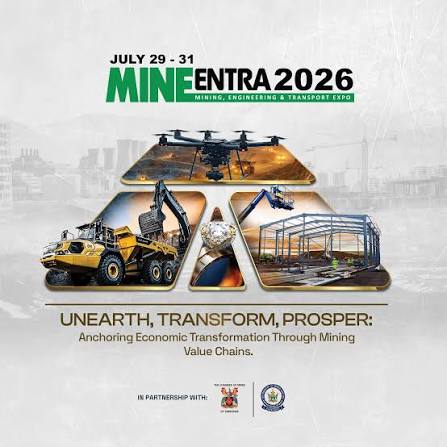
Industry and Commerce Minister Mangaliso Ndlovu has challenged Zimbabwean manufacturers to position themselves to capture a larger share of the mining sector’s US$3.4 billion procurement market, saying the country’s mineral wealth will only translate into broad-based economic growth if local industry becomes an integral part of the mining value chain.
Addressing delegates at the Mine Entra Suppliers Symposium in Bulawayo, Ndlovu said Zimbabwe could no longer afford to export minerals while importing most of the equipment, machinery and industrial inputs required to sustain the sector.
“Mining procurement represents one of the biggest opportunities for Zimbabwe’s industrialisation. We have a procurement market worth billions of dollars, but much of the manufacturing value is still created outside the country. Our objective must be to build local industrial capacity so that Zimbabwean companies manufacture more of what our mines consume,” Ndlovu said.
He said the government’s industrialisation agenda seeks to transform mining from an enclave industry into a driver of manufacturing, technology transfer, skills development and employment creation.
“The mining industry should become the anchor market for local manufacturers. Every pump, conveyor belt, steel structure, electrical component, chemical and engineering service that can be produced locally represents jobs created, foreign currency saved and industrial capabilities strengthened,” he said.
According to the Chamber of Mines of Zimbabwe, the mining sector generated approximately US$8.4 billion in revenue during 2025, with nearly US$3.4 billion spent on machinery, engineering equipment, transport services, electricity, chemicals and other operational inputs.
Despite the sizeable procurement bill, only about US$410 million worth of those products were manufactured in Zimbabwe, with the bulk comprising imported goods supplied through local distributors.
Ndlovu said closing that gap would require coordinated efforts by Government, financial institutions and the private sector to modernise factories, improve access to affordable long-term finance and strengthen technological capabilities.
“Local content is not simply about buying through Zimbabwean companies. It is about producing in Zimbabwe. That is where the real economic value lies, and that is the direction we must pursue if we are to build a resilient industrial economy,” he said.
Chamber of Mines of Zimbabwe chief executive officer Dr Isaac Kwesu said the mining industry had already created a strong domestic supplier base, but the next stage of growth must focus on increasing local manufacturing.
“Around 70 percent of mining procurement is sourced through local suppliers. However, local procurement should not be confused with local manufacturing because many suppliers import finished products before selling them to mining companies,” Kwesu said.
He said Zimbabwe was losing significant opportunities in manufacturing, technology development and skilled employment because many of the products used by the mining sector continued to be produced outside the country.
“When a mine buys imported pumps, drilling equipment, conveyor systems or industrial chemicals through a local distributor, we retain the trading margin, but we lose the manufacturing jobs, technological innovation and export potential associated with producing those goods locally,” he said.
Kwesu said the economic benefits of developing a domestic mining supply industry would extend well beyond the mining sector itself.
“Mining has a multiplier effect of three. Every dollar generated by mining creates another three dollars elsewhere in the economy through supplier industries and business linkages. If a greater proportion of procurement spending remains within domestic manufacturing, those multiplier effects become even stronger,” he said.
He added that Zimbabwe already possesses many of the building blocks required to establish a globally competitive mining supply industry, including engineering companies, steel manufacturers, foundries, technical universities and skilled artisans.
The push to deepen local manufacturing comes as Zimbabwe’s mining industry continues to record strong growth.
Speaking at the official opening of Mine Entra on Friday, Mines and Mining Development Minister Polite Kambamura said mineral export earnings reached approximately US$5.73 billion during the first half of 2026, comprising US$3.25 billion from gold and US$2.73 billion from other minerals.
“At these rates, we expect to surpass both our annual target for 2026 and the US$8.6 billion in mineral revenues recorded by the end of 2025. This demonstrates significant sectoral growth,” Kambamura said.
He said the industry’s growth reflected the Government’s deliberate policy of moving beyond raw mineral exports towards value addition and beneficiation.
“We are moving away from exporting high mineral volumes of low value to exporting smaller mineral volumes of higher value. That is the direction we are taking as we build a modern mining industry that delivers greater value to the economy,” he said.
Kambamura also reaffirmed the Government’s commitment to supporting small-scale miners, describing them as a strategic pillar of the country’s gold industry.
“The government remains resolute in formalising, financing, equipping and supporting this vital community, which sustains the livelihoods of well over 1.5 million Zimbabweans. We have reserved the small and medium-scale gold mining sub-sector for indigenous Zimbabweans while encouraging foreign investment in exploration, large-scale mining and beneficiation,” he said.
He said the Government would continue strengthening access to finance, technology and modern equipment to improve productivity, safety and environmental sustainability within the sector.
With mining production expanding and procurement expenditure continuing to rise, Ndlovu said Zimbabwe now has a rare opportunity to convert its mineral wealth into industrial growth by ensuring local manufacturers become the primary suppliers to one of the country’s fastest-growing sectors.
“The future of Zimbabwe’s industrialisation will not only be determined by the minerals we extract, but by the products we manufacture and the industries we build around those minerals. That is where lasting economic transformation lies,” Ndlovu said.